
Silk Road Travel FAQs: Everything You Need to Know About the Silk Road
The ancient Silk Road represents the most dazzling stage of civilization exchange and mutual learning in human history. The history of the Silk Road is a reflection on the centuries’ development of the economy, politics, culture and society of countries on the Eurasian continent, as well as the exchanges and integration of civilizations.
On the Silk Road, goods were exchanged, cultures collided, civilizations embraced and dialogue exchanged in many ways. Each country on the route is unique and charming, evolving as popular tourist destination. If you are planning for a Silk Road trip, then here are some frequently asked questions about Silk Road and answers for your reference.

What Was the Silk Road?
The term Silk Road is commonly used to refer to the overland route, but broadly, it can include both overland and maritime Silk Routes. It derives its name from the Chinese silk, the most famous good traded on this long route. Aside from silk, it also facilitated the exchange of other goods such as porcelain, spices, jade, and glass. More importantly, it fostered the spread of religions like Buddhism, Islam, and Christianity, as well as the blending of Greek, Persian, Indian, and Chinese cultures.
Is it safe to travel the Silk Road now?
It is a commonly asked question about Silk Road. Traveling along the Silk Road is generally safe. The China section (from Xi’an to Xinjiang) has good public security and well-developed infrastructure. The Central Asian section (Uzbekistan, Kazakhstan, etc.) is relatively stable in major cities but caution should be exercised against pickpockets.
The South Asian and Middle Eastern sections (such as Pakistan and Iran) may have areas with risks, and travelers should avoid conflict zones. It is recommended to check travel advisories in advance, respect local cultures, and pay attention to the safety of personal belongings. For first-time travelers, the China or Central Asia routes are safer options. With proper planning, Silk Road travel can be safe.

How Long Was It?
The traditional Silk Road has a total length of 6,440 kilometers. The section within China spans over 4,000 kilometers.
When Was the Silk Road Established?
The Silk Road originated during the Western Han Dynasty (202 BCE – 8 CE).
Who Started the Silk Road?
It was Zhang Qian who started the Silk Road. He was a renowned diplomat and explorer of the Western Han Dynasty, and was commissioned by Emperor Wu of Han to travel to the Western Regions. His two missions helped transform a small, informal trade route into an international communication passage between China and the world. The route he opened soon extended to the central hubs of Western civilization, such as Rome and Greece, forming what we now call the Silk Road.
What Was Traded?
During the ancient Silk Road era, silk, tea, porcelain, and lacquerware, have made their way from China to countries along the Silk Road. At the mean time, products such as jewels, medicinal material, spices and crops including grapes, sesame, walnuts, carrot and cucumber consist a steady flow entering China from the Central Asia, the West Asia and Europe. Among them, Silk was one of the first items to contribute to the development of the silk road out of all goods traded.
Where Did the Silk Road Start and Finish?
The Silk Road originated from the ancient Chinese capitals of Chang’an during the Han and Tang dynasties, passing through Central Asian countries, Afghanistan, Iran, Iraq, Syria, and reaching the Mediterranean, with Rome as its endpoint.

How Long Would It Take to Travel the Silk Road by Camel?
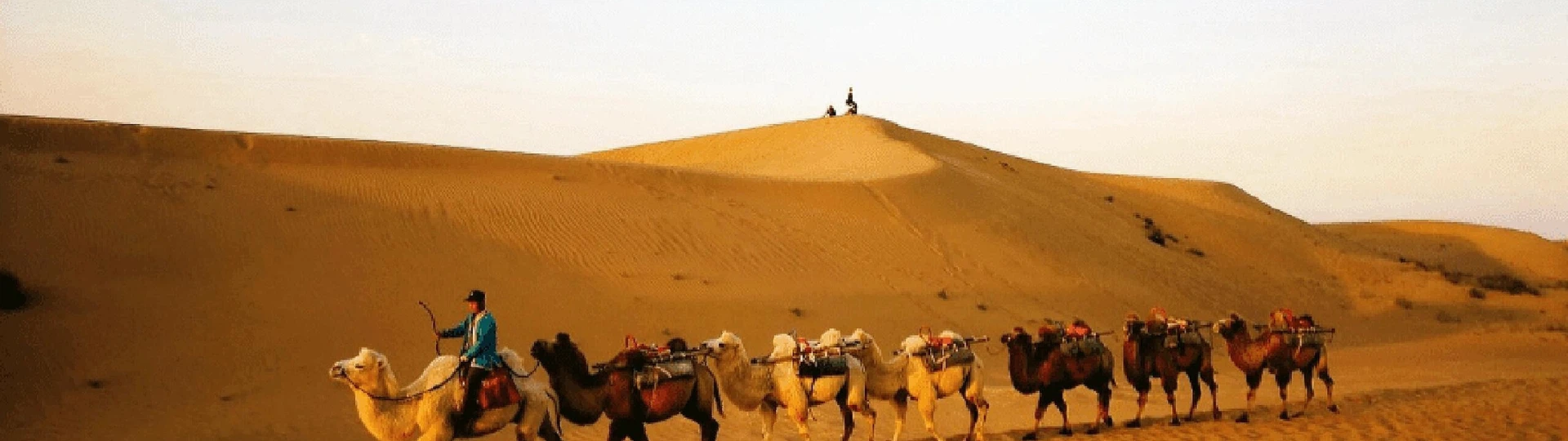
Traveling the Silk Road by camel was a laborious task lasting months to years. In ancient times, a complete east-to-west journey on the Silk Road could take a merchant caravan 1.5-2 years, factoring in rest stops, trade negotiations, and seasonal delays…
How Long Does It Take to Travel the Silk Road Today?
If you are traveling in the Chinese Silk Road cities, assuming you stay 1 – 3 days in each city, completing all the Silk Road cities with a regular pace would take 15 – 25 days. For a deeper exploration, it would take over 30 days. You could also extend your route to Qinghai and the southern Gansu region (such as Qinghai Lake, Chaka Salt Lake, etc.), which would cost approximately 35 days.
Globally, there are many Silk Road cities. Assuming 3 – 7 days per country, a quick tour would take 40 – 60 days, and an in-depth journey could take 90 – 120 days, or even longer.
Is It Still Used Today?
In 1453, the Ottoman Empire permanently closed the Silk Road. And as a result of the Age of Exploration which giving rise to faster routes between the East and West, the Silk Road gradually fell. But parts of the route continued to be critical pathways among various cultures.
Today, the Silk Road still sees active trade activities. The trade scale among Silk Road countries continues to expand, and trade forms have become more diversified, covering goods trade, services trade, cross-border e-commerce, and more. In terms of culture, the Silk Road remains an important link for cultural exchange. Countries along the route promote cultural integration and mutual learning through activities like cultural festivals and academic exchanges.
What Cultures Were Connected by the Silk Road?
The ancient Silk Road and the Maritime Silk Road were channels of civilization exchanges. Ethnic groups and cultures communicated and integrated thanks to the route. Running through dozens of countries across Asia, Europe and Africa, it connected and blended ancient civilizations like China, India, Egypt, Persia, Arabia, Greece and Rome. Cultural interactions between the East and West pervaded all respects of social life, from music, dance and astronomy to literature, language, clothing and customs.

What Is the Food Like along the China Silk Road?
The Silk Road food of China can be an active testimony to the centuries of cultural exchanges where the taste of the Central Asia, Middle East and China mingling into a special taste.
On the western reaches of the route, especially in Xinjiang, the influence of Turkic and Persian cuisines is unmistakable. Here the flavors are bold and aromatic, and the meals are centered on tender lamb, hand-pulled noodles and clay-oven-baked bread. The air is perfumed with cumin, chili and saffron in night markets where skewers sizzle over flame, and in bakeries where massive rounds of golden naan stack high. Further east, in Gansu and Shaanxi, the flavors change — heartier, earthier, yet still bearing traces of the Silk Road’s spice-laden past.
So eating your way along the Silk Road today is a journey through time. From the smoky kebab stalls of Kashgar to the steaming bowls of beef noodle soup in Lanzhou, every dish holds whispers of the merchants, monks and migrants who once traveled these ancient routes. It’s a travel of food culture without borders.